
How do I manage cash flow as my marketing agency grows?

Winning new clients and taking on bigger projects should be good news for a marketing agency.
The difficulty is that winning a £30,000 project doesn't put £30,000 in your bank account. You might have to pay freelancers and cover production costs for several weeks before you can even send the client an invoice. And while you're waiting for that payment, the agency still has salaries and its normal running costs to cover.
As you take on more projects, those commitments start to overlap. You can have a business that's growing and making a reasonable profit, yet find yourself worrying about whether there's enough money in the bank to pay everyone at the end of the month.
The question is how you manage that gap without having to worry about the bank balance every time you win another project.
Why does cash flow become more difficult as an agency grows?
Marketing agencies often have to pay for work long before the client settles the invoice.
You might need freelancers to deliver a campaign or have production costs to cover while a project is underway. Your employees still need paying every month, regardless of when the client pays.
Meanwhile, the client might not receive their final invoice until the project has finished. Even then, they could have another 30 days to pay it.
Your agency has to cover that gap.
With a relatively small number of projects, this may be manageable. But as the business grows, you can find yourself funding several projects at once.
Each new piece of work brings additional costs that need paying. Some of those costs may fall due before you've received payment for work that's already been completed.
It's quite possible for the agency to be making a reasonable profit on its projects while struggling to find the cash needed to deliver them.
How can a profitable project leave me short of cash?
Imagine your agency wins a £30,000 project.
You expect to spend £20,000 delivering it, leaving £10,000 before your other business overheads.
That looks like a good project to win.
But suppose £12,000 of the delivery costs need paying in the first month and the remaining £8,000 in the second.
Your client won't pay the £30,000 until the project finishes in month three.
Here's how the cash moves.
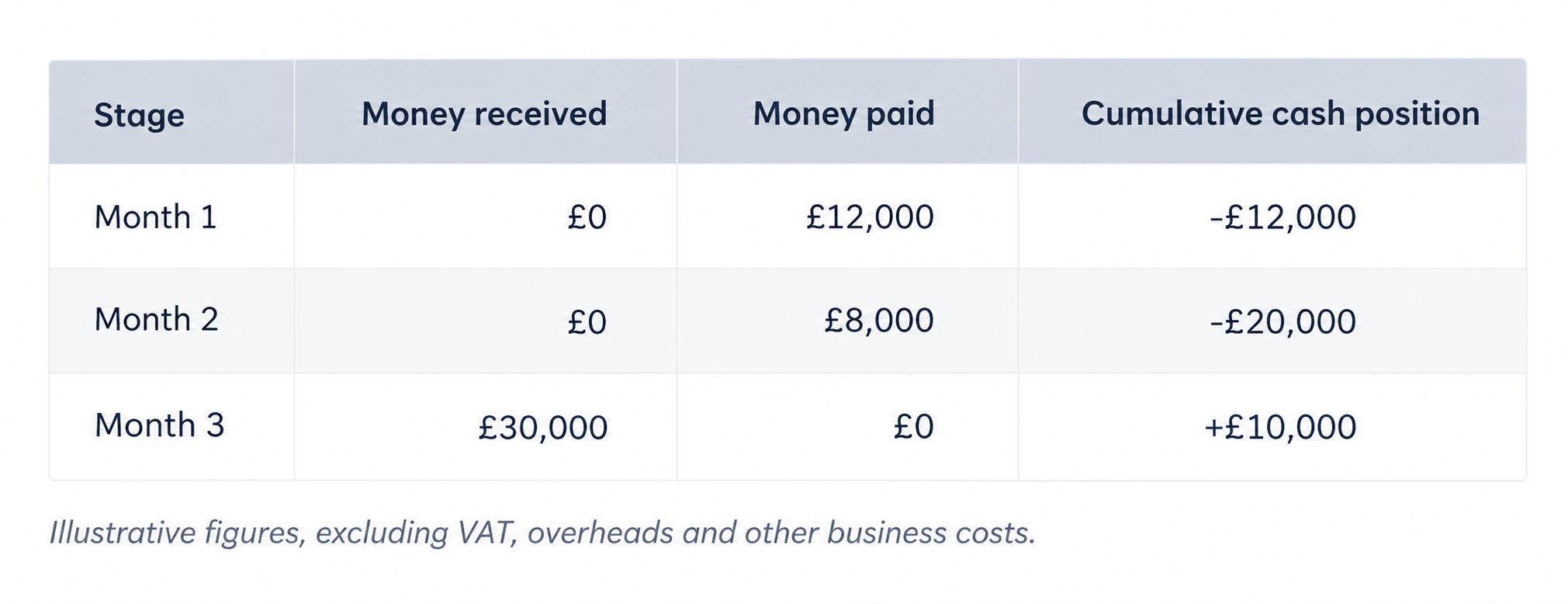
Illustrative figures, excluding VAT, overheads and other business costs.
Although the project should generate £10,000 before overheads, the agency needs £20,000 available to fund the work before the client pays.
Now imagine you've won several similar projects, all starting around the same time.
If you had three projects on those terms, you could need £60,000 in cash before the corresponding client payments arrive.
That's a considerable amount of money to have tied up in work, even when the agency is doing well.
And if a client pays later than expected, the pressure continues for longer.
Should I ask clients to pay a deposit?

I'd certainly consider it, particularly where the agency is committing significant expenditure at the start of a project.
Let's return to that £30,000 project.
If you agreed a 40% deposit, the client would pay £12,000 before the work began.
That would cover the first month's expected delivery costs.
The agency would still need to fund the remaining expenditure until another payment arrived, but the initial pressure would be considerably lower.
For longer projects, you might agree to invoice at particular stages of delivery.
The right arrangement will depend on the client and the nature of the work. Some clients will be comfortable paying a deposit, while others may have established purchasing procedures that make it more difficult.
What matters is understanding the effect those terms have on your agency.
If you're paying freelancers and suppliers weeks before receiving any money from the client, you're using your own cash to finance the project.
Sometimes that may be a commercial decision you're happy to make. But it's worth knowing how much money you're committing before agreeing to it.

How can I see whether we're going to run short of money?
One of the most useful things an agency owner can have is a forecast showing how much money is likely to be available over the coming weeks.
I think a 13-week cash-flow forecast is a sensible place to start.
It gives you a view of the next few months without trying to predict what the bank balance will look like a year from now.
You begin with the cash currently available and estimate what you expect to receive and pay out each week.
For an agency, that means looking closely at when client invoices are likely to be settled and when the costs of delivering projects will fall due.
You'll also need to allow for payroll and regular overheads, as well as tax payments that might be several weeks away.
One thing I'd be careful about is assuming clients will pay exactly when their invoices are due.
If a client normally takes 45 days to settle an invoice with 30-day terms, using the contractual due date in your forecast could give you a misleading picture.
It's better to use a realistic estimate and update it when you know more.
The forecast doesn't need to be perfect. Its value comes from giving you enough warning to make decisions before cash becomes a problem.
If you can see that several large supplier payments are due in the same week, you have time to consider how you'll cover them.
Do monthly retainers make cash flow easier?
They can, particularly when clients pay at the beginning of the month.
A predictable amount coming into the business makes it easier to plan expenditure.
But the payment arrangements still matter.
If your agency delivers work throughout October, invoices at the end of the month and receives payment in November, you're carrying the cost of October's work until then.
For agencies with substantial payroll commitments, that can create pressure even when most clients are on retainers.
I'd also keep an eye on how much work each retainer requires.
A £5,000 monthly fee may look attractive, but the client could be requiring more freelance support than originally anticipated.
You might find that the work is taking considerably longer to deliver than expected.
Over time, that affects how much cash the agency has left after paying the people doing the work.
It's worth reviewing those relationships periodically rather than assuming that recurring income will always provide a comfortable cash position.
How much cash should I keep in the business?
This is a question I think deserves more attention when an agency starts growing.
It's tempting to look at the current bank balance and decide whether it feels healthy.
But some of that money may already be committed to payments that haven't fallen due yet.
You could have a substantial balance immediately after receiving several client payments, only to find that much of it is needed for VAT, payroll or suppliers over the following weeks.
The amount of cash an agency needs will depend on how it operates.
An agency that invoices retainers in advance and has relatively predictable costs may be in a different position from one delivering large projects with significant upfront expenditure.
I'd use the cash-flow forecast to work out how much money is likely to be needed during the busiest delivery periods.
I'd also consider what would happen if a major client paid a month late.
That gives you a more useful basis for deciding how much cash to retain than choosing a fixed percentage of turnover.
What if cash flow is already becoming difficult?
If you're regularly worrying about whether the next set of payments can be covered, I'd start by looking at what is due over the next few weeks.
Which clients owe you money, and when are they realistically likely to pay?
What expenditure have you already committed to?
Are there projects underway that will require substantial additional spending before the next invoice can be raised?
You may find there are relatively straightforward changes available.
Perhaps an overdue invoice needs following up, or there's an opportunity to agree a payment when a particular stage of a project is completed.
But sometimes the underlying issue is how the agency takes on and finances its work.
If every new project requires a significant amount of upfront expenditure, continuing to win work on the same payment terms may increase the pressure.
That's something worth understanding before committing to further growth.
And if you can see that a tax payment or another important obligation may be difficult to meet, it's better to address that early.

How can I manage cash flow as the agency continues growing?
I'd make cash flow part of the conversation whenever you're deciding whether to take on substantial new work.
It's natural to focus on the fee and whether the agency has the capacity to deliver the project.
But I'd also want to know how much money the business will need to spend before the client pays.
If the agency is already funding several large projects, another profitable contract could still stretch its available cash.
That doesn't necessarily mean turning down the work.
It may mean agreeing different payment terms or arranging delivery so that expenditure is spread more evenly.
I'd also review the cash-flow forecast regularly rather than waiting until the bank balance becomes uncomfortable.
Over time, you'll begin to recognise how much cash the agency typically needs to support a particular level of work.
That can be valuable when deciding how quickly to grow and whether the business can afford additional permanent staff.
Is your agency growing but cash is getting tighter?
If you're winning more work but finding it increasingly difficult to manage the money coming in and going out, we can help you understand what's happening.
At Pisces, we work with marketing and creative agency owners to help them get a clearer picture of their finances and make informed decisions about growth.