
Cash Flow Forecasting: How to Prepare, Calculate and Use a Cash Flow Forecast.

Cash Flow Forecasting: How to Prepare, Calculate and Use a Cash Flow Forecast.
You've been thinking about taking on another employee, replacing some equipment or investing in the next stage of your business.
You check the bank balance and there's money available.
But how much of that money is already committed?
You've got wages, suppliers, VAT and other payments coming up. There are customers who haven't paid yet, and you can't be entirely sure when that money will arrive.
So before making another financial commitment, it would help to know what your cash position is likely to look like over the coming weeks and months.
That's where cash flow forecasting comes in.
It allows you to look ahead, understand when money is expected to come in and go out, and make decisions before a potential cash shortage becomes a problem.
And you don't necessarily need complicated software to get started.
What is cash flow forecasting?
A cash flow forecast estimates how much money your business expects to receive and pay out over a future period.
It starts with the cash you have available, adds the money you expect to receive and deducts the payments you expect to make.
What's left is your forecast closing cash balance.
You then carry that balance forward into the next period and repeat the calculation.
You can prepare a forecast weekly, monthly or over a longer period, depending on what you're trying to understand.
The important distinction is that we're forecasting when cash will actually move, rather than simply recording income and expenditure in your accounts.
A business can be profitable and still run short of cash.
You might complete a substantial piece of work and recognise the revenue in your accounts, but if the customer doesn't pay for another 60 days, that money isn't available to meet this month's payroll.
Similarly, you might purchase equipment that will be used for several years, but the cash could leave your bank account immediately.
Profit and cash flow are connected, but they're not the same thing.
Why is cash flow forecasting important?
The main benefit is being able to see a potential problem while you've still got time to do something about it.
If your forecast suggests you're going to struggle to meet your commitments in six weeks, you have an opportunity to review customer payments, reconsider expenditure or arrange suitable funding.
Discovering the same problem two days before payroll leaves you with considerably fewer options.
Forecasting also helps when things are going well.
You might want to recruit, expand into another market, invest in equipment or take on additional premises. Those decisions can involve commitments that continue long after the initial expenditure.
A forecast allows you to understand how those commitments will affect your cash position over time.
It can also help identify seasonal patterns, periods of unusually high expenditure or businesses that depend too heavily on receiving one or two large customer payments on time.

What information do you need for a cash flow forecast?
Before preparing a forecast, you'll need to gather information from your accounting records, bank account and any other records showing future financial commitments.
Your opening cash balance
Start with the cash genuinely available to your business at the beginning of the forecast.
For most businesses, this means reconciling the balances in their current and savings accounts, taking account of any known uncleared transactions or restrictions.
If you have several bank accounts, consider whether the funds can actually be used to meet the payments you're forecasting.
An overdraft facility may also be relevant, but it should be shown separately from your actual cash balance so you can see when the business would need to borrow.
Money you expect to receive
Look at your outstanding sales invoices and estimate when customers are likely to pay.
Your accounting system will show you what you're owed, but the invoice due date isn't always the date the money will arrive.
If a customer regularly pays two weeks late, it's sensible to reflect that in your forecast rather than assume they'll suddenly start paying on time.
You'll also need to include expected receipts from work that hasn't yet been invoiced, provided there's a reasonable basis for estimating when it will be completed, invoiced and paid.
For businesses receiving deposits, subscription income or regular direct debits, use the expected payment dates.
Keep speculative sales separate from contracted or highly probable receipts. That makes it easier to see how much of your forecast depends on winning future work.
Money you expect to pay
Now look at your expenditure.
That includes suppliers, payroll, employer contributions, rent, utilities, software subscriptions, loan repayments and other regular commitments.
You'll also need to allow for tax payments, including VAT, PAYE, corporation tax and any other liabilities relevant to the business.
VAT is particularly easy to overlook when you're thinking in terms of profitability rather than cash.
Depending on how your forecast is structured, customer receipts and supplier payments may include VAT. Your forecast must treat those figures consistently and include the payments due to HMRC.
Don't forget irregular commitments such as annual insurance, equipment purchases, bonuses or planned capital expenditure.
These can have a substantial effect on cash even though they don't appear every month.
How do you calculate a cash flow forecast?
The calculation itself is straightforward.
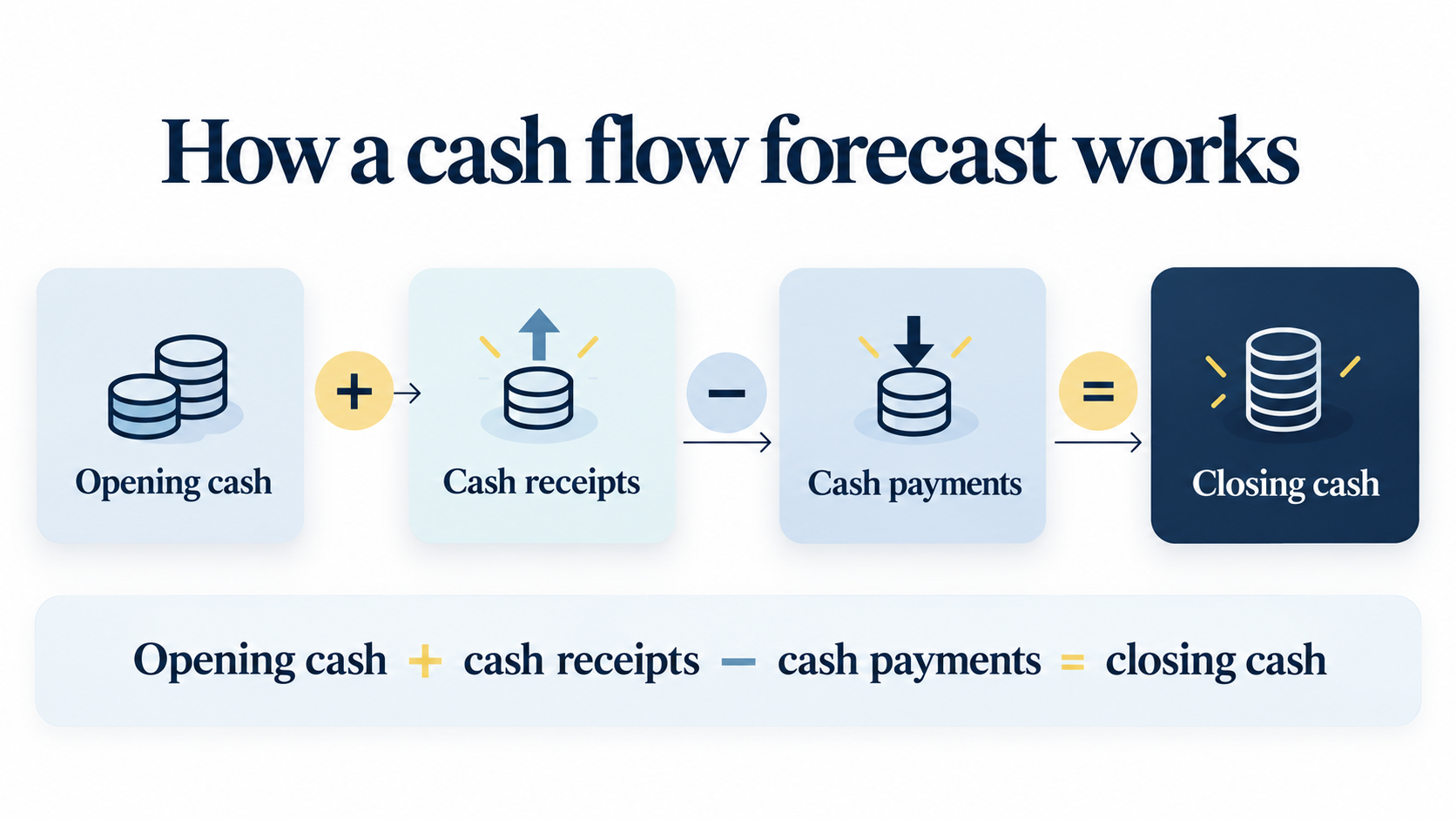
The closing balance from one period becomes the opening balance for the next.
For example, if you're preparing a weekly forecast, you'll calculate the expected closing cash balance for week one and then use that figure to begin week two.
You repeat the process for each week covered by the forecast.
The difficult part isn't the arithmetic.
It's making sensible assumptions about when customers will pay, when expenditure will fall due and what might change.
That's why a forecast needs updating regularly rather than being prepared once and forgotten.
Cash flow forecast example
Let's look at how this works in practice.
We'll use a fictional UK business preparing a four-week forecast. The figures are illustrative and designed to demonstrate the calculation, rather than represent a particular industry.
The business has an opening cash balance of £15,000. It expects to receive payments from customers throughout the month and has regular supplier, payroll and other commitments to meet.
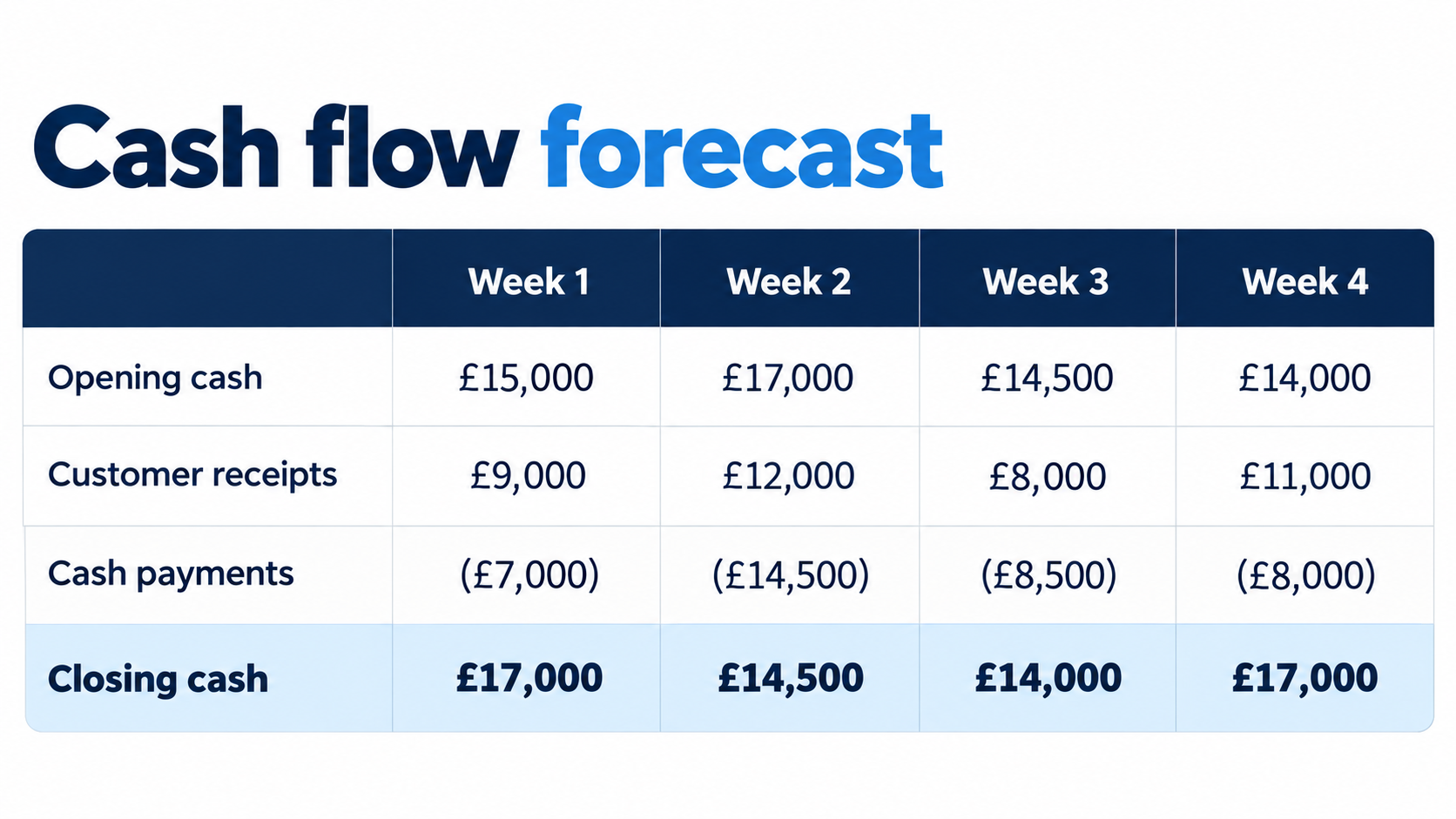
All amounts represent cash movements, with any applicable VAT included consistently in the receipts and payments.
Looking at this forecast, the business appears to have sufficient cash throughout the four weeks.
The balance moves up and down as receipts and payments fall due, but it remains positive.
By the end of week four, the business expects to have £17,000 available.
Based on those assumptions, there doesn't appear to be an immediate shortage.
But forecasts are only as reliable as the assumptions behind them.
What happens if a customer pays late?
Now imagine that the £12,000 expected in week two doesn't arrive.
The customer advises that payment will be delayed until week four.
The work has been completed and the invoice is still owed, but the business doesn't have access to the cash when expected.
Let's see what happens to the forecast.
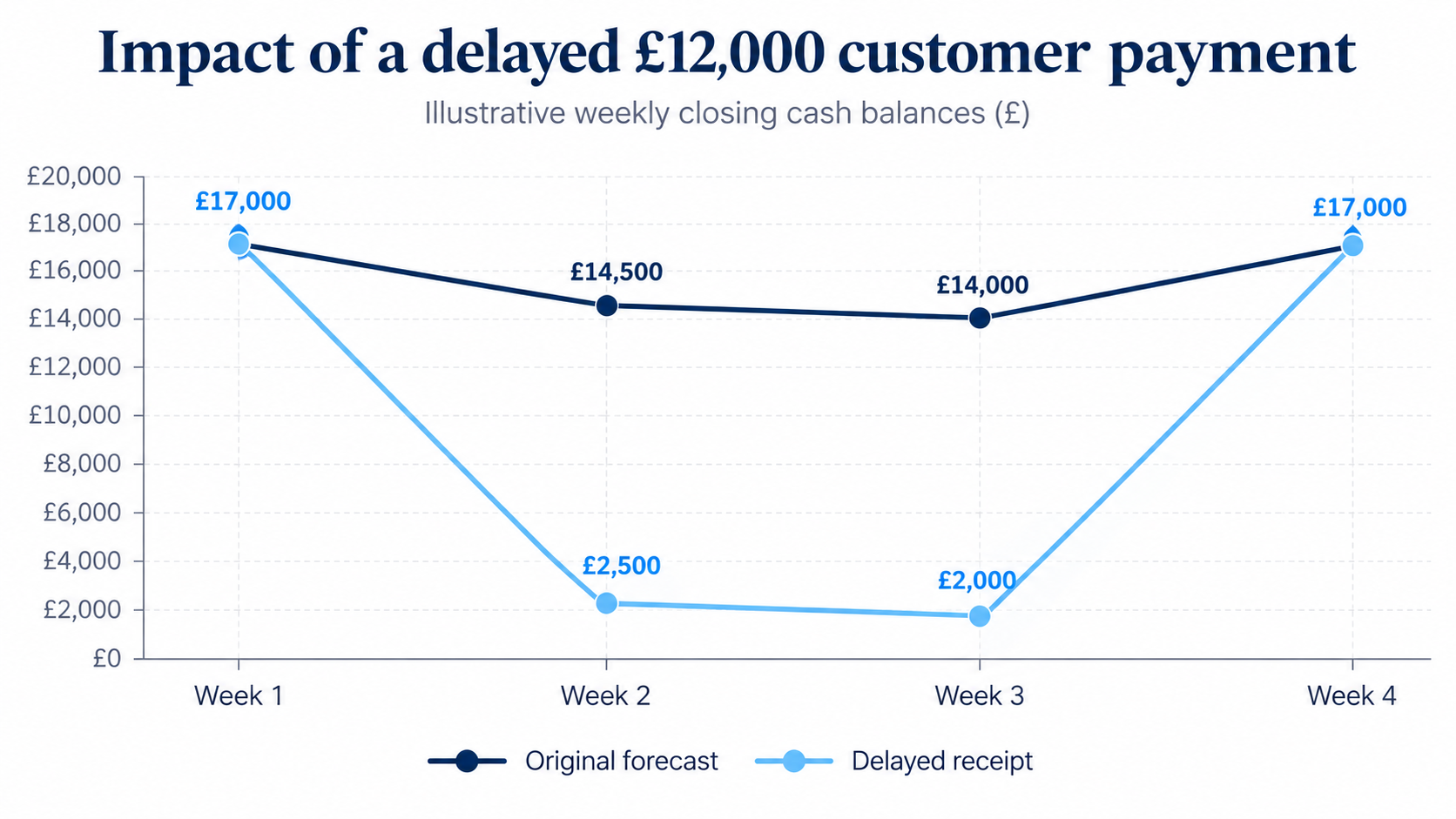
The business finishes week four with the same expected balance.
But the position during weeks two and three is completely different.
Instead of having £14,500 at the end of week two, the business has just £2,500.
By the end of week three, that falls to £2,000.
And remember, we're only looking at weekly closing balances. Cash could fall even lower during the week if significant payments leave the account before customer receipts arrive.
The business may still be profitable. Its customers may still owe exactly the same amount.
But its ability to meet immediate commitments has changed considerably.
That's why looking ahead matters.
What should you do when your forecast shows a shortage?
The purpose of identifying a potential shortage isn't simply to produce a worrying number on a spreadsheet.
It's to understand what options are available before the problem arrives.
You might start by contacting customers with outstanding invoices, particularly where payments are overdue or expected shortly.
If substantial expenditure is planned, you could reconsider whether it needs to happen immediately.
You might also review payment arrangements with suppliers, provided any changes are agreed rather than simply delaying payments without discussion.
For a growing business, there may be a case for arranging an appropriate working capital facility before it becomes urgently necessary.
And sometimes the forecast tells you that the business needs to change its plans.
Perhaps an additional employee is affordable over the next twelve months, but recruiting immediately would leave the business exposed during the next six weeks.
That doesn't necessarily mean abandoning the recruitment.
It might mean changing the start date, reviewing the work coming into the business or ensuring that sufficient cash is available before making the commitment.
The forecast gives you information to support that decision.
How to prepare a cash flow forecast in Excel
You don't need specialist forecasting software to get started.
A straightforward spreadsheet can be sufficient, particularly for a smaller business with a manageable number of transactions.
I'd start by putting the forecast periods across the top of the sheet.
For a short-term forecast, these might be individual weeks. For longer-term planning, you might use months.
Then create rows for the opening cash balance, customer receipts and the main categories of payments.
Separating payments into categories such as payroll, suppliers, tax, rent and finance costs makes it easier to understand where the cash is going.
The spreadsheet should calculate the total receipts and payments for each period and then determine the closing balance.
That closing balance carries forward automatically into the following period.
As actual receipts and payments occur, update the forecast and compare what happened with what you originally expected.
If customers are consistently paying later than forecast, that's something worth investigating.
The same applies if expenditure is regularly higher than expected or costs are appearing that weren't included in the original forecast.
Over time, those comparisons help improve the accuracy of your assumptions.
The important thing is to keep the spreadsheet manageable.
A forecast with hundreds of lines isn't necessarily better than one that clearly identifies the significant cash movements and financial risks.
Should you prepare a weekly or monthly cash flow forecast?
That depends on the business and the decisions you're trying to make.
A rolling 13-week cash flow forecast can be particularly useful when you need to manage short-term commitments.
It provides a detailed view of the next three months, allowing you to see when customer receipts, payroll, tax and other payments are expected.
For a business experiencing tight cash flow, updating that forecast weekly may be appropriate.
A six- or twelve-month forecast serves a slightly different purpose.
It helps you consider longer-term decisions such as recruitment, investment, expansion or changes to financing arrangements.
For many growing businesses, I'd use both.
The short-term forecast helps manage the immediate cash position, while the longer-term forecast supports financial planning.
The two should be consistent, although they don't necessarily need to contain the same level of detail.
Common cash flow forecasting mistakes
One of the most common mistakes is assuming that an invoice will be paid on its due date.
Payment terms are useful, but your customers' actual payment behaviour may provide a more realistic basis for forecasting.
Another is overlooking tax.
Businesses sometimes focus on customer receipts and supplier payments without allowing properly for VAT, PAYE or corporation tax liabilities.
It's also easy to overlook annual expenditure or planned investments, particularly when preparing a forecast from recent monthly transactions.
A further mistake is treating the forecast as something that must be correct.
It won't be.
Customers pay late, work gets delayed, unexpected expenditure arises and plans change.
A forecast is an estimate based on the best information available at the time.
Its value comes from being updated and used regularly.
Finally, be careful about assuming that a forecast showing a positive closing balance means the business can afford every planned commitment.
You need to consider how much cash should reasonably be retained to deal with uncertainty, the timing of payments within each period and any restrictions on available funds.
What are the limitations of a cash flow forecast?
A forecast cannot remove uncertainty.
If you're relying on winning new contracts, receiving substantial customer payments or achieving ambitious sales targets, your closing balance may depend heavily on things that haven't happened yet.
This is why I prefer separating reasonably certain receipts from more speculative income.
It can also be useful to prepare alternative scenarios.
What happens if sales are lower than expected? What if a major customer pays late? What if you need to replace equipment earlier than planned?
You don't need dozens of different versions, but testing a few assumptions can help identify where the business is most vulnerable.
The further into the future you forecast, the greater the uncertainty is likely to become.
That's another reason to review forecasts rather than rely indefinitely on the original figures.
Using cash flow forecasting to make better business decisions

Once you've prepared a forecast, the real benefit comes from using it.
Imagine you're considering taking on another employee.
You know what the salary will be, but there's more to consider than the annual amount.
There are employer costs, the timing of payroll, recruitment expenditure and possibly a period before the new employee begins generating additional revenue.
Your forecast allows you to see how those commitments affect the cash available over the coming months.
The same applies to investing in equipment, expanding your premises or committing to a new service.
And when a business begins to grow more quickly, these decisions often become connected.
Taking on a new contract might require additional staff. Those employees need paying before the customer settles the first invoice. The business may need to fund several months of delivery before receiving the cash.
The contract might be profitable, but you still need to finance the work.
That's where forecasting becomes more than an exercise in preparing a spreadsheet.
It becomes part of how you run the business.
How often should you update your cash flow forecast?
For a business using a 13-week forecast to manage its working capital, I'd generally suggest reviewing it weekly.
Update the bank balances, replace estimated receipts and payments with actual figures, and review what has changed.
Look particularly at movements that are materially different from expectations.
Has a customer payment slipped? Has expenditure increased? Have you committed to something that wasn't included previously?
For longer-term forecasts, a monthly review alongside the management accounts can be appropriate, although businesses facing significant financial uncertainty may need more frequent updates.
The frequency should reflect how quickly circumstances change and how closely cash needs to be managed.
There's little value in producing an elaborate forecast every month if nobody reviews what it says or uses it to make decisions.
When might you need help with cash flow forecasting?
Preparing a basic cash flow forecast is something many business owners can do themselves.
But as a business grows, keeping that forecast reliable can become more demanding.
You may have several revenue streams, different customer payment arrangements, multiple departments, new employees and investment decisions that affect future cash commitments.
The challenge becomes less about calculating the closing balance and more about understanding the assumptions, assessing the risks and deciding what action to take.
That's where regular financial reporting and Finance Director support can become particularly valuable.
At Pisces, our Virtual Finance Director services help growing businesses understand their financial position, plan ahead and work through important commercial decisions.
If you're considering recruitment, expansion or a significant investment and want a clearer view of your future cash position, we can help you build and maintain forecasting that supports those decisions.
Book a free consultation with Pisces
The important thing is to start forecasting before cash becomes an immediate problem.
With a clear view of expected receipts, payments and commitments, you've got more time to make decisions and considerably more options available when circumstances change.