
Can I Afford to Hire Another Employee?

There comes a point in the growth of most businesses when you begin to wonder whether it's time to recruit somebody else. You might have more work coming in than your existing team can comfortably handle, or perhaps you're finding yourself spending too much time on day-to-day tasks when you should be concentrating on developing the business.
Taking on another employee can seem like the obvious answer, particularly when you've got a healthy pipeline of new work. The difficulty is knowing whether the business can afford the additional commitment, not just today but over the months and years ahead.
Before making that decision, it's worth looking beyond the salary and considering what the employee will actually cost, the additional profit they could help generate and how their appointment might affect your cashflow.

How much does it really cost to employ someone?
When you're considering recruiting somebody on a salary of £35,000, it's tempting to think of that as an additional £2,917 a month. Unfortunately, the actual cost to the business will be higher once you include employer National Insurance, workplace pension contributions and the other expenses that come with employing somebody.
For the 2026/27 tax year, employers generally pay National Insurance at 15% on earnings above the £5,000 annual secondary threshold. Most employers must also contribute to a workplace pension, with the statutory minimum commonly calculated at 3% of qualifying earnings.
Using our £35,000 employee as an example, the annual costs would look like this:
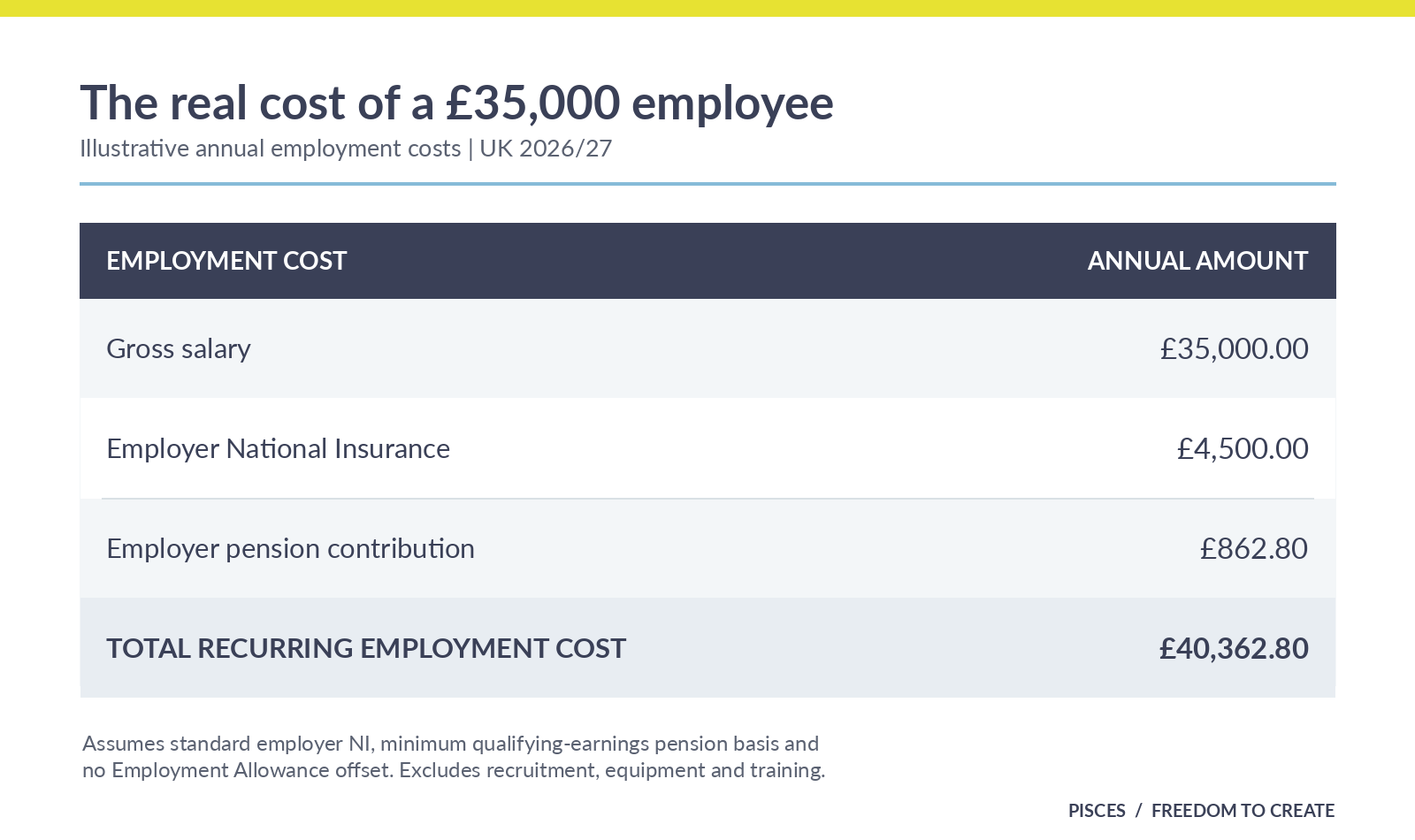
This assumes the standard National Insurance category and minimum pension contributions based on qualifying earnings. It also assumes no reduction in the employer's NI liability through Employment Allowance, which eligible businesses may be able to claim.
The costs beyond their salary
There are other costs to consider, some of which arise before your new employee has completed their first day's work.
Recruitment fees, computer equipment, software subscriptions and initial training can all add to the investment. You also need to allow for the time existing employees will spend helping their new colleague settle in, particularly where the role requires specialist knowledge of your systems, clients or processes.
For illustration, let's assume we spend £1,500 on recruitment, £1,000 on equipment and software setup, and a further £1,000 on training and onboarding.
Our first-year investment becomes approximately £43,863, equivalent to £3,655 a month when spread across the year.
Those additional amounts are illustrative rather than standard costs. Some businesses will spend considerably more on recruitment, while others may already have much of the equipment and training capacity available.
It's also important to distinguish costs paid upfront from the ongoing monthly commitment. Spreading everything over twelve months helps us understand the investment, but it doesn't reflect when the cash will actually leave the bank.
How much additional profit does the business need to generate?
Knowing the cost is only part of the decision. We also need to understand what the business expects to gain from employing somebody.
For a creative agency, another designer might allow the business to take on projects that it would otherwise have turned away. An ecommerce company could recruit somebody to manage operations, while a SaaS business might need additional development or customer support capacity.
In each case, the employee may create value in different ways. Some roles directly generate revenue, whereas others free up existing employees, reduce outsourcing costs or improve the service customers receive.
The important question is how much additional financial benefit the appointment can realistically deliver.
Working out the break-even point
Let's continue with our first-year employment cost of approximately £43,863.
If the employee allows the business to generate additional sales, we need to understand how much of those sales remains after paying the direct costs associated with delivering them.
Suppose the business earns a contribution margin of 40% on its additional revenue. This means that, for every £100 of new sales, £40 remains towards covering the employee's cost and contributing to profit.
On that basis, the business would need approximately £109,657 of additional annual revenue to recover the £43,863 first-year investment.
That's around £9,138 of additional monthly revenue.
The calculation changes significantly if the business achieves a higher contribution margin or the new employee replaces costs that are already being incurred. If employing somebody allows you to stop spending £30,000 a year on freelancers, for example, that saving needs to form part of the assessment.
It's also worth remembering that additional revenue isn't necessarily the only measure of success. A new employee might allow the owner to spend more time winning work, improve client retention or remove a bottleneck that's preventing the business from growing.
These benefits can be valuable, but we should be realistic about their financial impact rather than assuming they will automatically pay for the new role.

Can your cashflow support another employee?
A business can be profitable and still struggle to meet its monthly commitments, particularly when customers take longer to pay or expenditure increases ahead of new revenue.
Recruiting another employee introduces a regular cost that must be paid regardless of whether the business has had a particularly successful month.
Using our example, the recurring salary, employer NI and pension costs amount to approximately £3,364 a month on an annualised basis. The business needs to be able to support those costs even when new projects are delayed, customers pay late or sales temporarily fall.
What happens during the first 12 months?
I'd want to look at a rolling 12-month cashflow forecast before making the decision.
We would start with the existing forecast and introduce the new employee's costs from their anticipated starting date, allowing for recruitment expenditure, monthly payroll and the timing of any additional revenue.
It's unlikely that somebody joining the business will immediately operate at full capacity. There may be several months of training and familiarisation before their contribution reaches the level we originally expected.
If the appointment is intended to support growth, we also need to consider whether the additional work has already been secured or whether we're relying on sales that haven't yet materialised.
The forecast should show the effect on the bank balance throughout the year, particularly the lowest projected cash position, rather than simply whether the business expects to make a profit by year-end.
That helps us understand whether recruitment is affordable and whether sufficient cash remains available for the other commitments the business already has.
What if the business doesn't grow as expected?
We can't predict exactly how the next twelve months will unfold, but we can consider what might happen if things turn out differently from our original expectations.
Let's assume the additional employee is expected to support £120,000 of annual revenue at a 40% contribution margin.
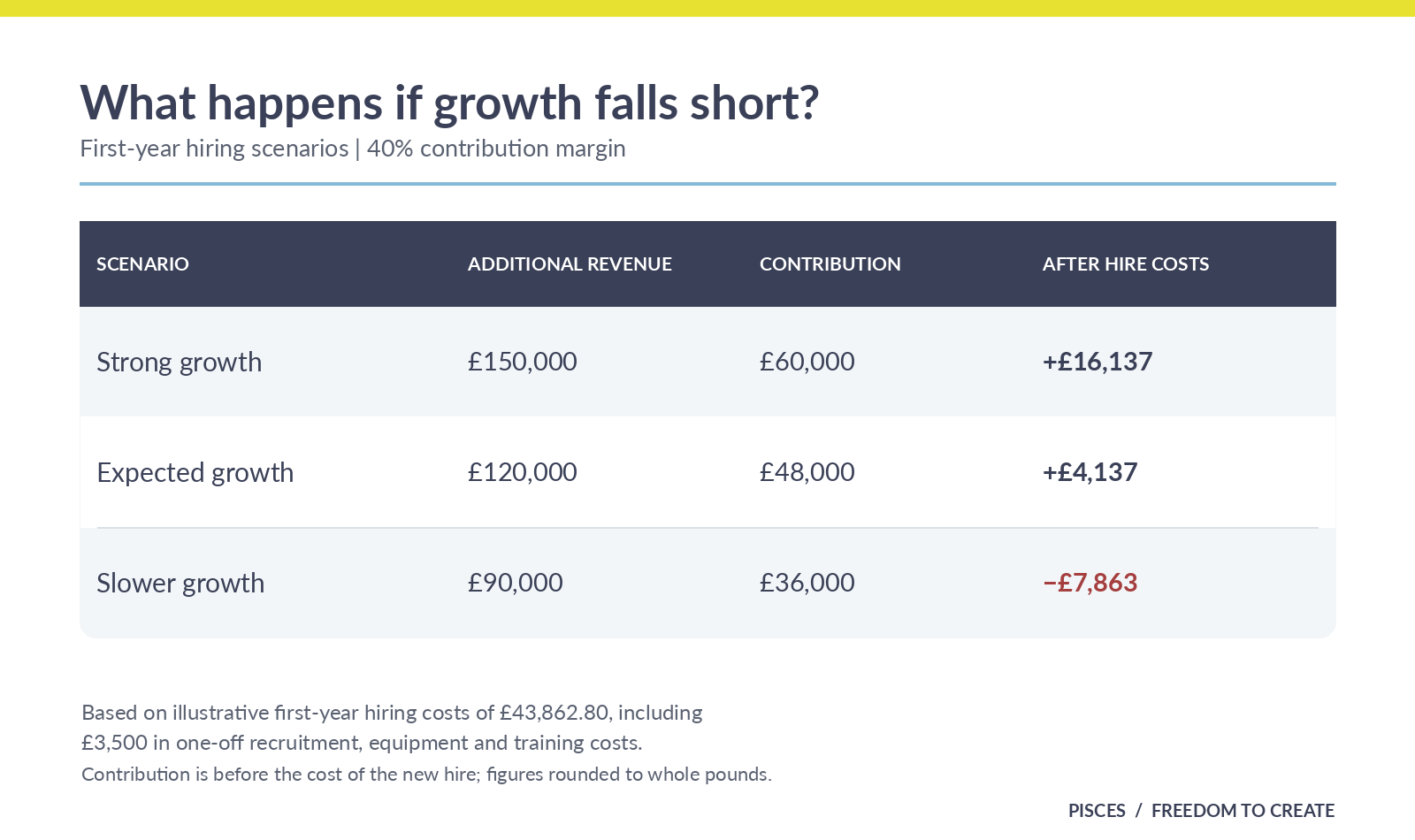
Illustrative figures based on £43,863 first-year employment costs, a constant 40% contribution margin and no other incremental overheads.
The expected scenario produces a positive financial return, although the margin for error isn't particularly generous. A relatively modest shortfall in revenue would be enough to turn the investment into a loss during the first year.
That doesn't necessarily mean recruiting would be a mistake. The employee could deliver much greater value in the second year once the initial costs have been absorbed and they're working at full capacity.
However, understanding the downside before making the commitment gives the business an opportunity to decide whether the risk is manageable.
Could you afford not to hire someone?
It's easy to concentrate on what another employee will cost without considering what might happen if you decide not to recruit.
If your existing team is already operating at capacity, delaying recruitment could mean turning away profitable work, relying increasingly on expensive freelancers or placing unreasonable demands on employees who are already stretched.
There's also the owner's time to consider. If you're spending a substantial part of your week dealing with operational work that somebody else could manage, you may be limiting your ability to develop the business.
The challenge is putting a reasonable value on those opportunities.
It's not enough to assume that another employee will create growth. We need to understand what additional capacity they provide, whether the demand exists to use it and what the business stands to lose by delaying the appointment.
Are there alternatives to taking on another employee?
Before committing to a permanent position, I'd also consider whether the existing business could operate more effectively.
Sometimes a growing workload is a sign that additional people are needed, but it can also reflect inefficient processes, poor project management or work being delivered at prices that don't adequately cover the resources involved.
For a creative agency, understanding the profitability of individual projects might reveal that the team is spending too much time servicing particular clients. Recruiting another employee without addressing that problem could simply increase costs without improving profitability.
Other businesses might benefit from automating repetitive tasks, outsourcing specialist work or using freelancers until demand becomes more predictable.
These alternatives aren't necessarily cheaper in the long term, but they may offer greater flexibility while the business establishes whether it has enough work to support another permanent employee.

How can you make the decision with confidence?
By the time you've considered the full cost of employment, the financial contribution you expect the employee to make and the effect on your cashflow, you should have a much clearer picture of whether recruitment makes commercial sense.
I'd want to be satisfied that the business understands the following before making an offer:
The total recurring employment cost and any initial recruitment investment.
The additional contribution or cost savings the appointment is expected to generate.
How the hire affects the next twelve months of profitability and cashflow.
Whether the business can manage a period of slower growth.
Whether recruitment is the best solution to the problem we're trying to address.
There may still be some uncertainty, particularly where the business is recruiting ahead of expected growth. That's normal, provided the assumptions are reasonable and the business understands the financial risks it's taking.
How a Virtual Finance Director can help
Recruitment decisions are rarely made in isolation. They affect profitability, working capital, the capacity of the business and often the owner's own financial expectations.
Having a reliable forecast and a clear understanding of the numbers makes it easier to assess the options, particularly when you're considering several appointments or entering a period of growth.
At Pisces, our Virtual Finance Director service helps business owners understand the financial implications of decisions like these, using management information, forecasting and scenario planning to look beyond the immediate costs.
The objective is to give you the clarity and confidence to make the right decision for your business, whether that means recruiting now, waiting a few months or taking a different approach.
Thinking about your next hire? Find out how Pisces can help you plan with confidence.
Frequently asked questions
How much does it cost to employ someone on £35,000 a year?
Using standard 2026/27 UK employer National Insurance and minimum qualifying-earnings pension assumptions, the recurring annual cost is approximately £40,363 before recruitment, training, equipment and other overheads. Actual costs depend on the employee's circumstances, pension arrangements and any employer reliefs.
How do I know whether my business can afford another employee?
Start by calculating the full employment cost and comparing it with the additional contribution or savings you expect the employee to generate. Then include the appointment in a 12-month cashflow forecast to assess whether the business can meet its commitments, including during quieter periods.
Should I hire a permanent employee or use a freelancer?
That depends on how consistent the workload is and whether the business needs someone on an ongoing basis. Freelancers can provide flexibility for individual projects, while permanent employees may be more appropriate where there's sufficient recurring demand and a long-term need for the role.
What if I need another employee but can't afford one yet?
You may be able to improve existing capacity, outsource some work, recruit part-time or delay the appointment while building sufficient cash reserves. Understanding the financial gap between your current position and the cost of recruitment will help you decide what needs to change.