
How Much Should Your Agency Charge?

How Much Should Your Agency Charge? A Practical Guide for Creative and Marketing Agencies.
One of the difficult things about running a creative agency is knowing what to charge for your work.
You can look at what competitors are charging, ask around or work backwards from what you think a client might be prepared to pay.
And sometimes you'll win a project at a price you're quite happy with.
Then the work starts.
The client wants another round of revisions. The project takes longer than you expected, and the creative director ends up spending far more time on it than anyone allowed for.
By the time you've finished, you might have delivered a brilliant piece of work without making much money from it.
The problem isn't necessarily that you quoted too little. It might be that you didn't really know what the project needed to earn in the first place.
So how do you work that out?
1. Why copying another agency's prices doesn't work
It's natural to want to know what other agencies are charging.
If you're quoting £8,000 for a branding project and someone else is charging £15,000, you probably want to understand why.
But comparing prices only tells you so much.
An agency with three employees working from a small studio will have a very different cost base from an agency employing twenty people in a city-centre office.
Even agencies of a similar size can have quite different costs.
One might employ experienced senior designers, while another uses a mixture of junior staff and freelancers. Some agency owners spend most of their time delivering client work, while others are concentrating on winning new business.
And there's the question of what the client is actually buying.
A branding project that includes extensive research, workshops and strategic development isn't necessarily comparable with one focused mainly on visual identity.
You can learn something from competitors' pricing, particularly about what clients are prepared to spend. But it doesn't tell you whether the price will work for your agency.
To understand that, you need to look at your own numbers.

2. Work out what it really costs to run your agency
Let's take an established creative agency with a team delivering branding and marketing projects.
We'll use some simple annual figures.
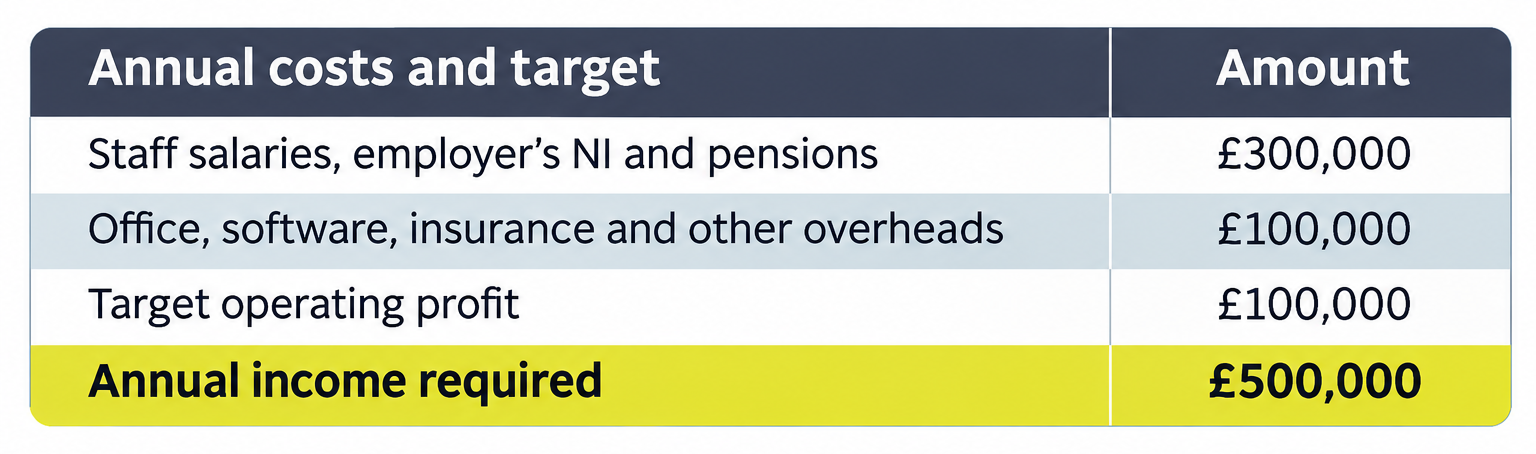
Illustrative figures. The example assumes all relevant operating costs are included in the amounts above.
This agency needs to generate £400,000 a year to cover its operating costs.
If the owners want to make £100,000 in operating profit, it needs £500,000 of income after any separately accounted-for external project costs.
That £100,000 profit isn't simply money sitting around waiting to be spent.
The business might need to fund equipment, repay borrowing, build cash reserves or support future growth. Corporation tax also needs to be considered when looking at what remains available.
But at least we've now got a starting point.
The agency knows how much it needs to earn.
What we haven't established is how much work it can realistically deliver to generate that income.
And that's where many pricing calculations start to go wrong.

3. Why the hours you can actually sell matter
Imagine our agency has a delivery team with 10,000 contracted working hours between them each year.
You might be tempted to divide the £500,000 income target by those hours.
That gives you £50 an hour.
It looks straightforward enough.
Unfortunately, it assumes every contracted hour can generate income from client projects.
In practice, that isn't going to happen.
People take holidays and have time off sick. They attend meetings, help with pitches and spend time developing their skills.
Senior staff might spend considerable time reviewing work or supporting other team members.
None of this necessarily means the agency is being inefficient. Much of it is simply part of running a business.
But it does mean that you have fewer hours available to recover your costs.
This is why understanding staff utilisation matters.
Utilisation is the proportion of available working hours spent delivering client work.
For this example, let's assume the agency has 10,000 working hours available after holidays and other absences. We can then see what happens at different levels of utilisation.
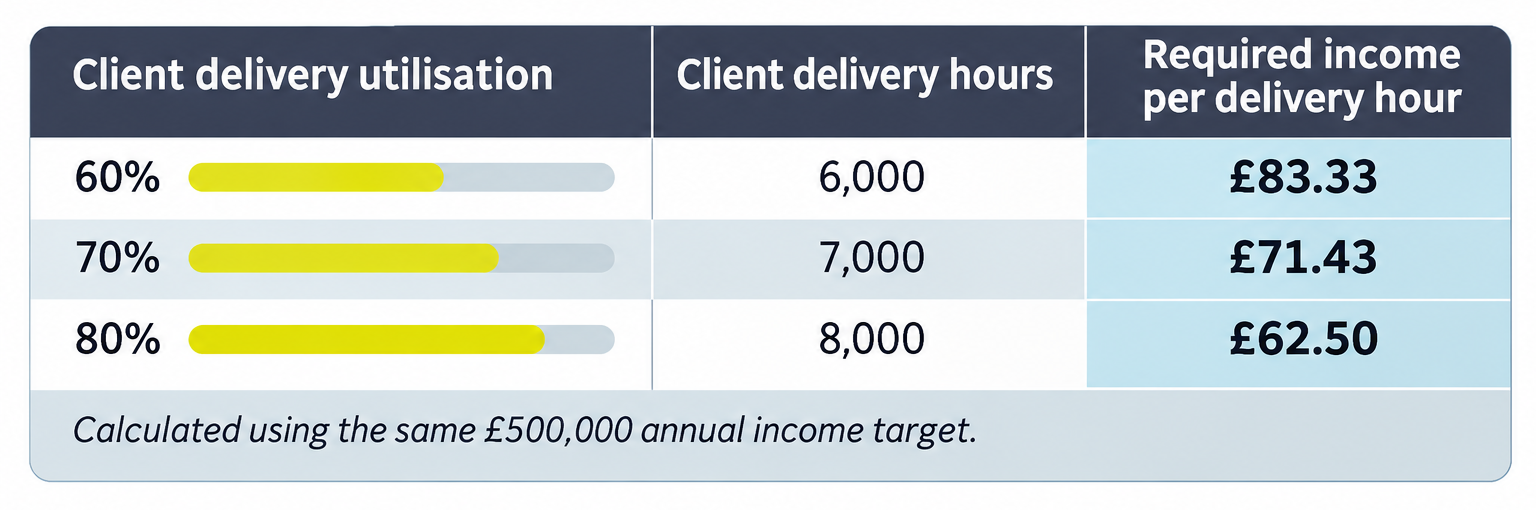
Calculated using the same £500,000 annual income target.
That's quite a difference.
At 60% utilisation, the agency needs to recover approximately £83 for every hour spent delivering client work.
At 80%, it needs £62.50.
The underlying business costs haven't changed.
The difference is how many hours are available to generate the required income.
Of course, this doesn't mean everyone should be working at 80% utilisation.
A creative director who spends time developing new business or managing the team will have a different role from a designer whose time is primarily spent delivering projects.
Trying to achieve extremely high utilisation across everyone can create problems of its own.
These calculations are also not necessarily the hourly rates you should quote to clients.
They're a way of understanding how much income the agency needs to generate from its available delivery time.
And they give you something useful to work with when pricing projects.

4. Turning those numbers into a project price
Let's say a potential client approaches the agency about a new branding project.
After discussing the brief, the team estimates it will require 120 hours of work.
If the agency is using a required recovery rate of £75 per delivery hour, that gives us:
120 hours × £75 = £9,000
That's a starting point for the price, rather than necessarily the final quote.
We also need to think about the work involved.
Will the agency need to pay for photography, illustration or other external services?
Are those costs included in the project fee, or will they be charged separately?
How confident are we about the estimated hours?
And what happens if the client asks for something that wasn't included in the original brief?
Suppose the project requires £1,500 of external photography costs, which haven't been included in the agency's annual operating cost calculation.
If those costs are passed on without a markup, the starting price becomes £10,500.
The agency might decide that the value of the work to the client supports a higher price. Equally, it may need to reconsider the scope if the client's budget is lower.
The important thing is that the agency now understands the financial implications of the price it agrees.
It can decide whether a project is commercially worthwhile rather than relying entirely on what feels like a reasonable fee.
What about retainers?
The same principle applies.
Imagine you're charging a client £3,000 a month for ongoing marketing support.
You originally expected the work to require 30 hours a month.
At that level, the client is generating £100 of income per delivery hour.
But what if the work gradually increases to 45 hours?
You're now generating just £66.67 per hour.
The monthly fee hasn't changed, and the client might be perfectly happy.
But the economics of the relationship have changed considerably.
This is why it's worth reviewing the actual time spent on retainers, even where clients are paying a fixed monthly amount.
It isn't about billing for every minute.
It's about knowing whether the work you're agreeing to deliver is still commercially sensible.

5. How do you know whether you're charging enough?
You can spend a lot of time working out what a project should cost.
But once the work is underway, you need to see whether your assumptions were reasonable.
Let's return to our branding project.
The agency quoted £12,000 and expected the work to take 120 hours.
That works out at £100 of income per planned delivery hour, before considering any external costs.
But the project actually takes 160 hours.
The income per delivery hour has now fallen to £75.
That's a 25% reduction in the income earned per delivery hour.
It doesn't automatically mean the project made a loss.
To establish the actual profit, we'd need to consider the cost of the people doing the work and any other project costs.
But it does tell us that the project used considerably more of the agency's capacity than expected.
And those extra 40 hours weren't available for other client work.
I'd want to understand what happened.
Perhaps the project was more complicated than anticipated. Maybe the original estimate didn't allow enough time for client feedback.
Or perhaps additional work was agreed along the way without anyone considering the effect on the budget.
If similar projects are regularly overrunning, that's something the agency needs to take into account when preparing future quotes.
Look at the work you're winning as well as the work you're delivering
There's another side to pricing that can be easy to overlook.
What happens when you increase your fees?
You might win fewer projects, but the projects you do win could be considerably more profitable.
Or you might discover that a particular type of client is much more sensitive to price than another.
That's why I'd look at your quotation success rate alongside the profitability of completed work.
If you're winning almost every project you quote for, it may be worth investigating whether you're pricing too cautiously. It isn't proof that your prices are too low, but it's worth understanding.
Equally, if you're losing a lot of opportunities on price, you need to know whether that's because your fees are genuinely uncompetitive or because you're attracting clients who aren't a good fit for the work you offer.
The aim isn't necessarily to win more projects.
It's to win enough of the right work at prices that make the business worthwhile to run

What I'd look at first
If you're not sure whether your agency is charging enough, I'd start by looking at a handful of recently completed projects.
Choose a mixture of jobs, including some that went well and others that were more difficult.
Compare what you originally quoted with the actual time spent delivering the work.
Look at the external costs and calculate what was left after paying for the resources used.
Then consider whether the original estimate was realistic.
You may find that certain types of work are consistently profitable while others regularly take longer than expected.
And if you're quoting new projects using the same assumptions you've always used, those patterns are worth understanding.
A price that worked for your agency two years ago might not work today.
Staff costs have increased, the mix of work may have changed and the amount of time your senior people spend managing the business could be quite different.
I'd be particularly interested in whether the agency has updated its pricing to reflect those changes.
Because you can be delivering better work, employing more people and bringing in more revenue without necessarily making any more profit.
How much should a marketing agency charge per hour?
There isn't a single hourly rate that works for every agency. It depends on your staffing costs, overheads, available delivery hours and the profit you need to make.
Start by calculating how much income your agency needs to generate, then divide that by the hours realistically available for client work. This gives you a useful internal recovery rate, although it isn't necessarily the rate you should quote to clients.
Should creative agencies charge hourly or use fixed project fees?
Both approaches can work.
Fixed fees give clients greater certainty about what they'll pay, but they depend on estimating the work accurately and managing changes to the agreed scope.
Hourly pricing can be useful where the work is difficult to define in advance.
Whichever approach you use, you still need to understand the cost of delivering the work and whether the fee leaves enough profit.
Are you charging enough for the work your agency delivers?
If you're winning projects and keeping everyone busy, but the profit isn't quite where you'd expect it to be, it might be worth looking more closely at the numbers.
At Pisces, we work with creative and marketing agency owners to understand which projects make money, where margins are slipping and whether their pricing is supporting the business they want to build.