
When Does Your Business Need a Finance Director?

There isn't a particular turnover figure that tells you it's time to appoint a Finance Director.
I've come across businesses with several million pounds of turnover that manage their finances reasonably well without one. I've also seen much smaller businesses where the financial arrangements haven't kept pace with what's happening.
For me, it's less about the size of the business and more about what's appearing in the accounts, whether anyone understands the reasons behind it and what's being done to address it.
Some problems are fairly obvious. Others develop gradually, and by the time they become a concern, they may have been affecting the business for months.
Here are five things I'd pay attention to when reviewing a company's accounts.
1. Your Outstanding Debtors Keep Increasing
Have a look at the aged debtors report from your last few month-end accounts.
How much was outstanding three months ago compared with today? More importantly, how much of it is overdue?
Let's say your business had £45,000 outstanding in July. By October, that's increased to £95,000.
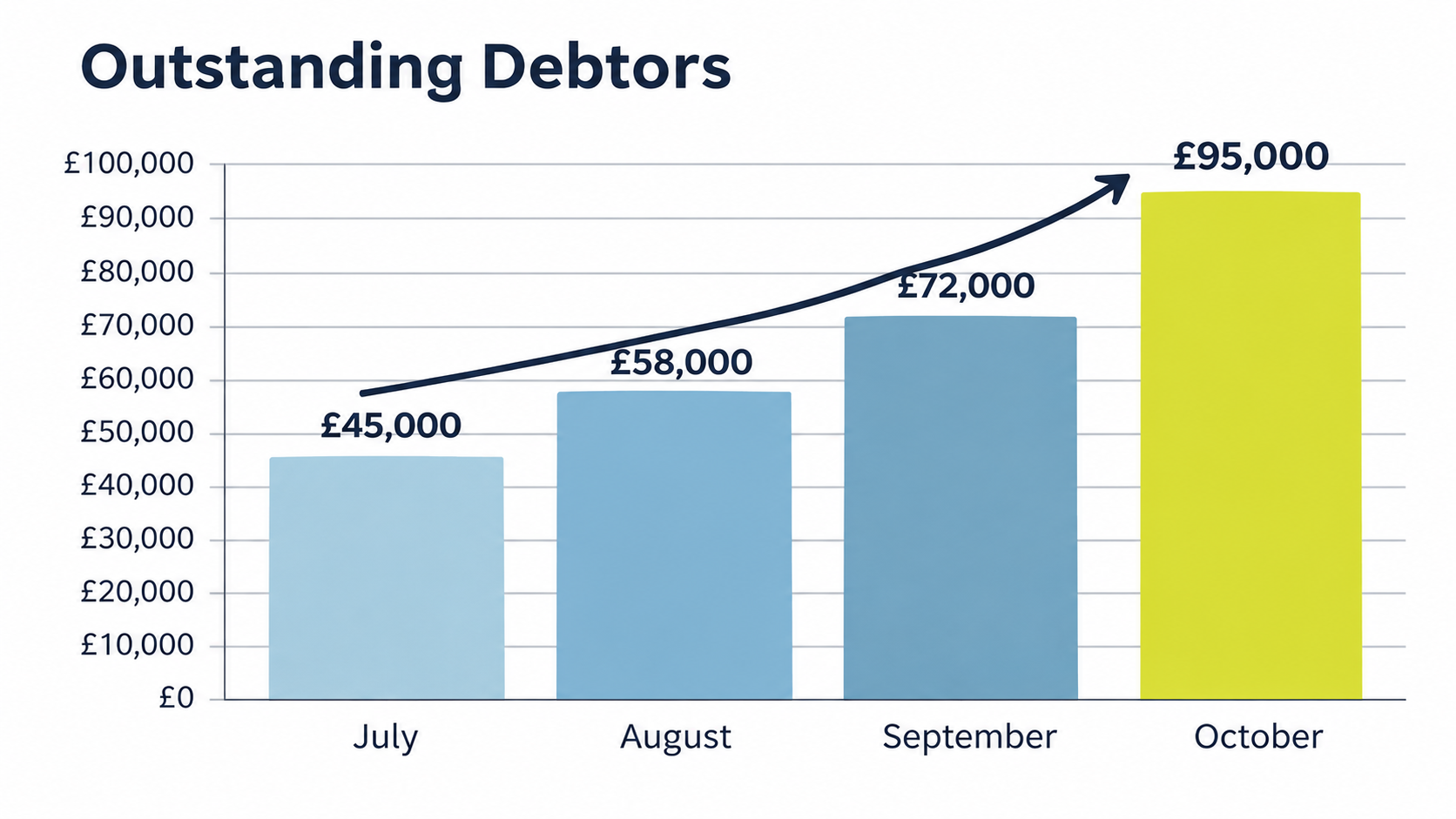
There could be a perfectly reasonable explanation. Perhaps you've invoiced a large contract just before the month end, or revenue has increased significantly.
But I'd want to see what's happening to the older balances.
If invoices that were 30 days overdue last month are now 60 days overdue, something needs investigating.
It might be that nobody is regularly chasing payments. In a smaller business, that responsibility sometimes sits with someone who's also dealing with several other things, and credit control gradually slips down the list.
Or perhaps invoices are being disputed because additional work wasn't agreed properly with the customer.
I'd look at debtor days, the ageing of outstanding invoices and whether particular customers are regularly paying late.
What concerns me isn't simply that debtors have increased. It's when overdue balances keep growing and nobody appears to be getting on top of them.
That can become an expensive problem, particularly when the business has already incurred the costs of supplying the goods or services.
2. The Profit Margins on Your Products, Services or Projects Are Falling
This is one I'd pay particular attention to.
Suppose your management reports show that the average gross profit margin was 42% six months ago.
It's now 25%.
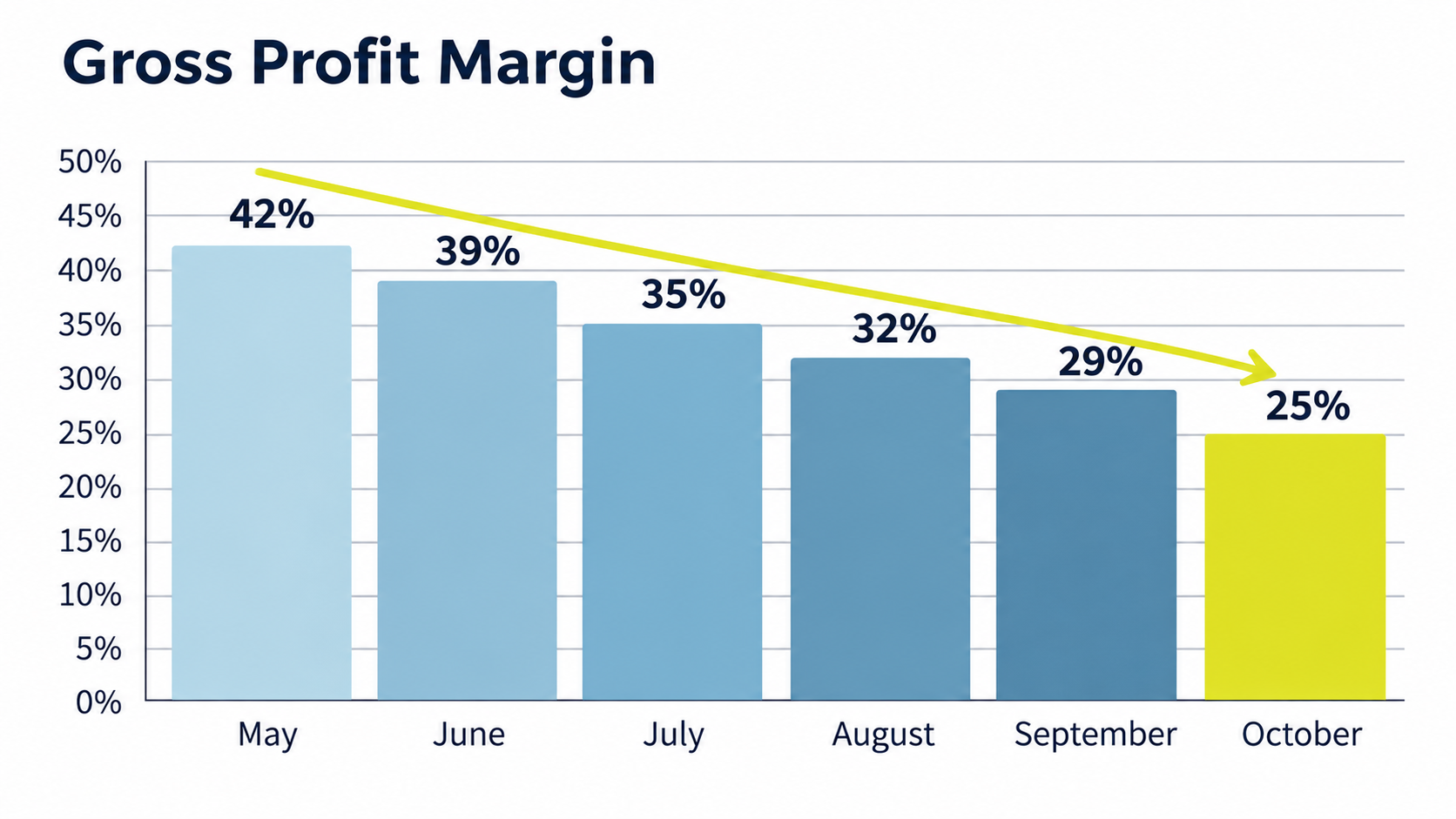
You might have noticed individual jobs running over budget, products becoming more expensive to supply or services requiring more resources than expected.
But have you looked at whether it's becoming a pattern across the business?
For example, take a project that was sold for £20,000.
You expected the direct costs to be £12,000, leaving £8,000 of gross profit.
But by the time the work was completed, the actual costs had reached £15,000.
Your gross profit has fallen from £8,000 to £5,000.
That's a reduction in gross margin from 40% to 25%.
What caused the additional £3,000 of costs?
Perhaps delivery took longer than anticipated. Suppliers may have increased their prices, additional work might not have been charged for, or the original estimate may have been unrealistic.
For a product business, the problem could be higher purchasing costs, shipping charges or discounting.
I'd also want to know whether anyone noticed the margin deteriorating while the work was being carried out or the products were being sold.
If the same pattern is appearing across several products, services or projects, it needs investigating.
It might be your pricing, purchasing costs, inefficient processes or the way work is being managed.
But until you understand what's causing the margins to deteriorate, you won't know what needs changing.
3. Revenue Is Increasing, but Operating Profit Isn't
Let's look at a business's results over two financial years.
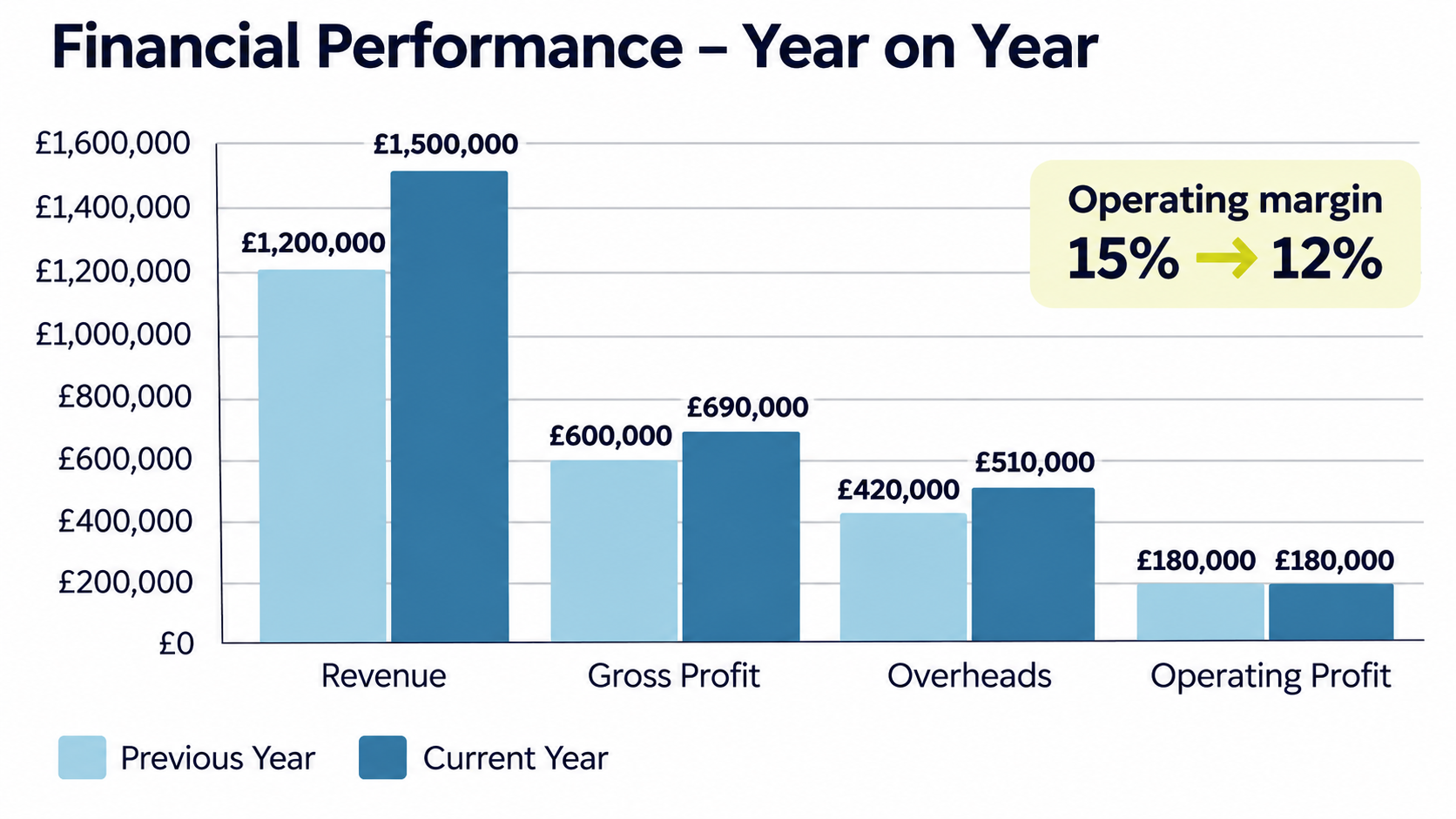
Revenue has increased by £300,000, but operating profit hasn't changed.
I'd want to understand what the business has spent the additional money on.
The gross profit margin has fallen from 50% to 46%, which suggests that direct costs have increased relative to revenue.
Overheads have also increased by £90,000.
Perhaps the business recruited additional staff, invested in management or took on larger premises.
Some of those investments could be worthwhile, particularly if they're expected to improve future performance.
But I'd want to know whether the results were in line with what the owners expected when they made those decisions.
If the business had planned for operating profit to increase to £250,000, there's a substantial difference that needs explaining.
I'd also compare staff costs, overheads and gross margins over several periods rather than relying solely on the annual totals.
There may be a good reason for the additional spending.
The concern is when profitability has been deteriorating for some time and the business hasn't investigated why.
4. You're Reporting Profits, but Your Cash Balance Keeps Falling
Imagine your business reports £60,000 of profit over the last three months.
During the same period, the bank balance has fallen from £110,000 to £35,000.
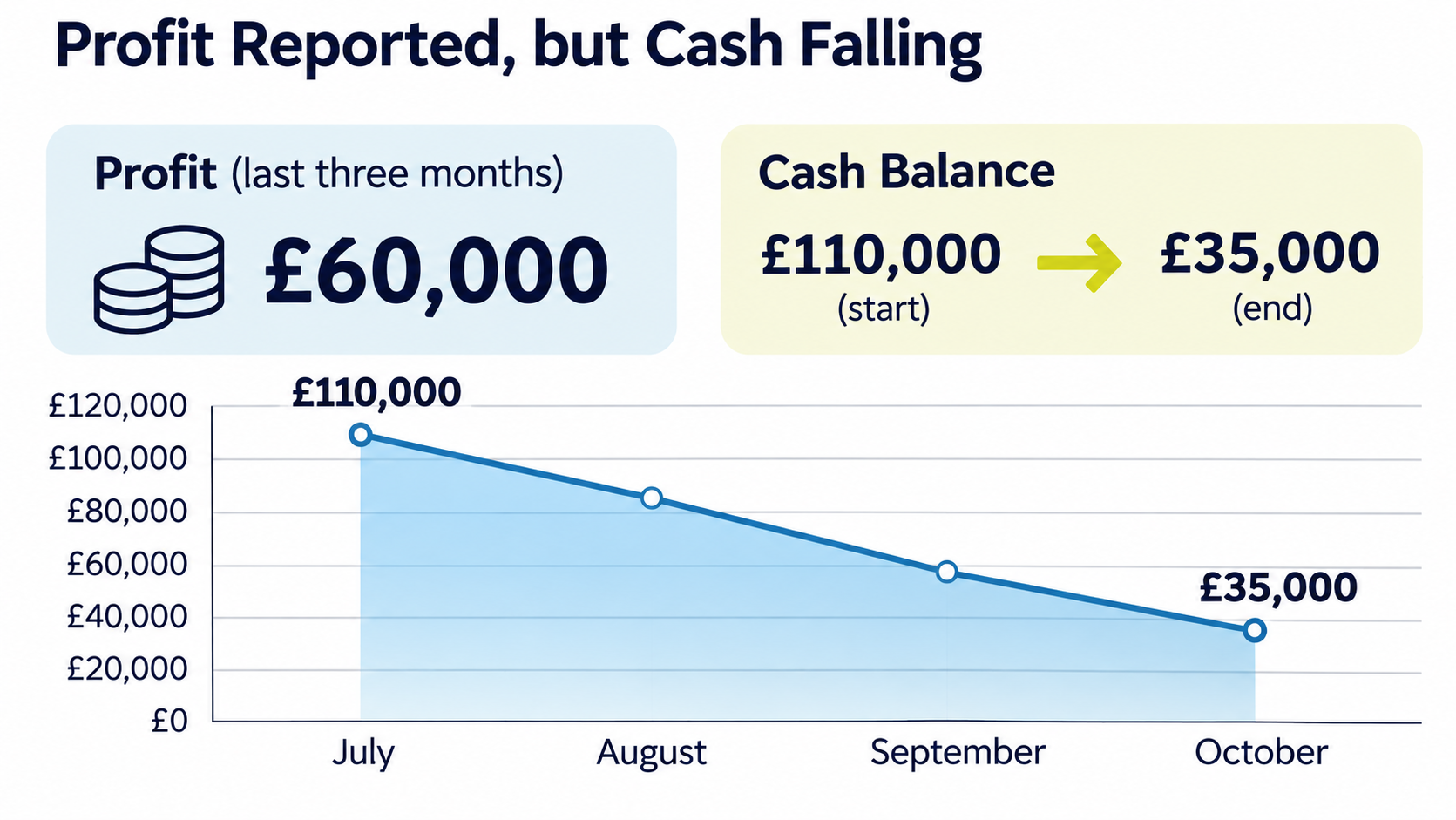
I'd want to reconcile that movement.
A profit and loss account won't tell you everything that's happened to the cash.
Some of the profit might be sitting in unpaid customer invoices. The business could have made VAT or corporation tax payments, purchased equipment, repaid a loan or made distributions to shareholders.
None of those explanations necessarily means there's a problem.
But it's important to understand where the money has gone.
For example, if the business has £80,000 more tied up in debtors than it did three months ago, that would help explain why profits haven't translated into cash receipts.
I'd also want to look at what's coming up.
How much is due to be collected from customers over the next four weeks?
What payments are expected for payroll, suppliers and tax?
Does the business have enough cash available if a major customer takes another month to pay?
This is where I'd expect to see a regularly updated cash flow forecast, ideally looking at least 13 weeks ahead for short-term cash management.
A falling cash balance isn't necessarily a warning sign on its own.
But if the business is repeatedly surprised by how little money is available, despite having regular management accounts, there's clearly something missing from the financial information being used.
5. You're Taking Longer to Pay Your Suppliers
The aged creditors report is another place I'd look.
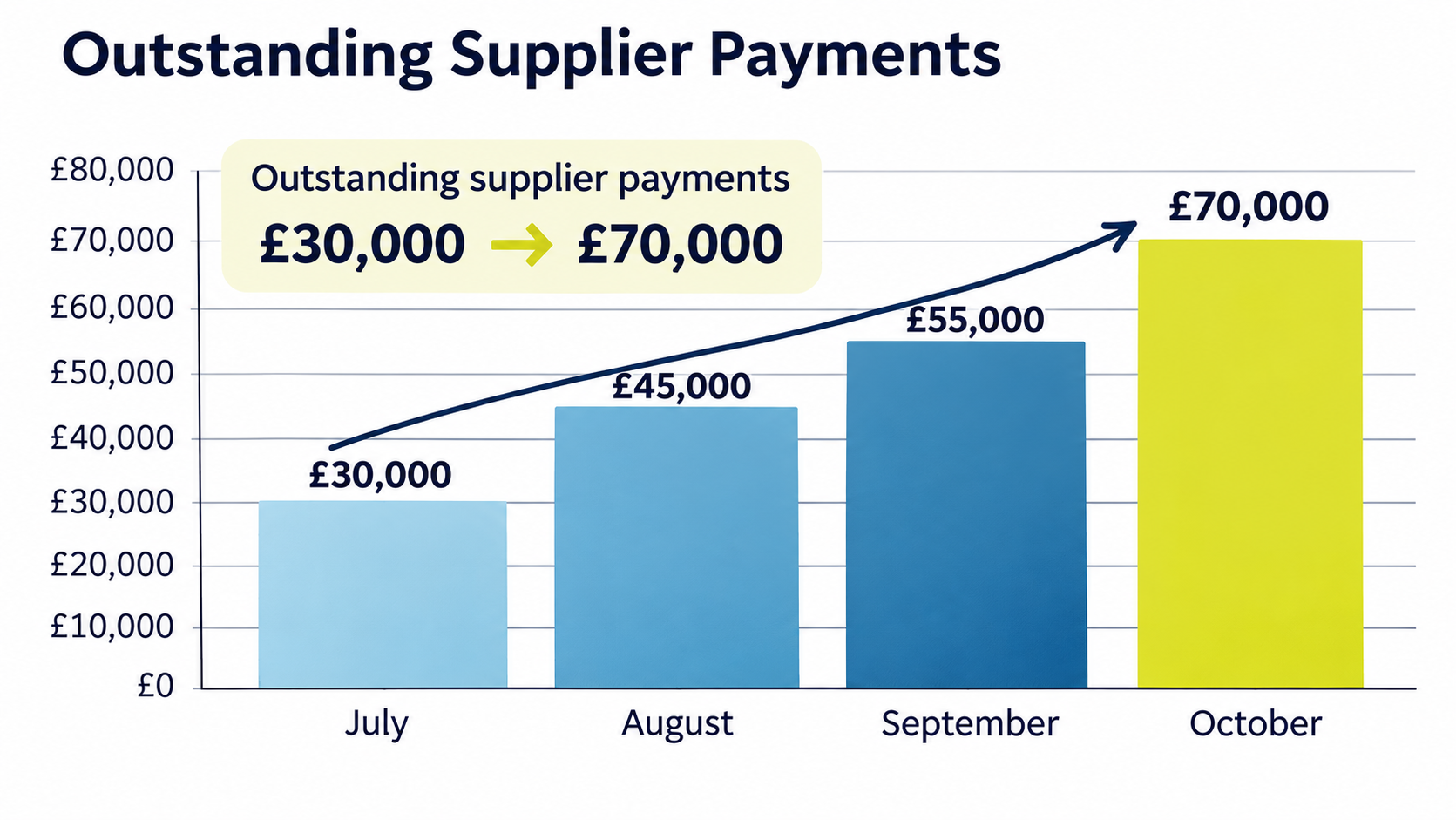
Suppose the business normally has around £30,000 of outstanding supplier invoices at the month end.
Over the last few months, that's increased to £70,000.
Again, the total balance isn't necessarily the issue.
You might have incurred additional costs on a large contract, purchased more stock or received invoices close to the reporting date.
What I'd be more interested in is how much is overdue.
If invoices that used to be settled within 30 days are regularly taking 60 or 90 days, I'd want to understand what's changed.
Perhaps the business is delaying payments because the cash isn't available.
Or invoices are sitting in an approval process, and nobody has a clear picture of what's outstanding.
Consistently late payments can also damage relationships with suppliers you depend on.
I'd review the creditor balances alongside the cash flow forecast and the aged debtors report.
Are supplier payments being delayed because customer payments are coming in late?
Has the business taken on contracts that require significant upfront expenditure?
Or have the payment approval processes become unreliable?
There are several possible explanations, and the accounts should help you narrow them down.
If you're routinely stretching supplier payments to get through the month, I'd be concerned about what happens when a large tax payment or an unexpected expense comes along.
What If You're Seeing More Than One of These Warning Signs?
This is where I'd start looking at the bigger picture.
Let's say your debtors have been increasing for several months. At the same time, your gross profit margins have deteriorated, and you're now taking longer to pay suppliers.
You might initially treat these as separate problems.
The late payments need chasing. Costs need reviewing. Supplier invoices need approving sooner.
But I'd want to investigate whether there's a connection between them.
Perhaps increased costs have reduced the cash available to the business. Customer payments are arriving later, and supplier payments are being delayed as a result.
Or there might be problems with how work is completed and invoiced, leading to delays in collecting money.
That's only one possible explanation. You'd need to examine the financial records and operational information before drawing any conclusions.
But it's the sort of investigation that can be missed when different people are dealing with individual problems without reviewing the overall financial position.
And it's one reason why I think regular management accounts should be accompanied by a proper discussion about what's happening in the business.
Does This Mean You Need a Finance Director?
Not necessarily.
If overdue invoices are the only problem, the answer might be to introduce a proper credit control process.
If profit margins are falling, you might need to review pricing, purchasing costs or how services are delivered.
But if several of these problems are developing and nobody is taking responsibility for investigating the reasons, it's worth considering whether the business needs more experienced financial support.
A Virtual Finance Director can review the financial information, identify areas that need investigation and work with the management team to address them.
That might involve improving reporting, examining profitability, developing cash flow forecasts or putting better financial controls in place.
For an established business, the benefit is having somebody who understands its financial position and can spend time examining issues that might otherwise be overlooked.
You don't need to wait until there's a serious cash flow problem or a particularly disappointing year before looking at how your finances are managed.
Sometimes the warning signs have been sitting in the accounts for quite a while.
How Pisces Can Help
At Pisces, we provide Virtual Finance Director and finance function services to established businesses, including creative agencies, SaaS and ecommerce companies.
If you've noticed some of these warning signs in your accounts and would like to understand what's causing them, we can help you review your financial position and work out what needs attention.
Book a free consultation with Pisces